6 Test Methods
6.1 Standard Test Conditions
The standard test conditions of this standard are: ambient temperature (23 ± 2) ℃, relative humidity (50 ± 5)%.
6.2 Sample Handling Before Testing
The samples to be tested should be within their storage period, and all test materials should be placed under standard test conditions for at least 24 hours.
6.3 Preparation of Test Samples
6.3.1 Asbestos cement board: The base material of asbestos cement board is Class I board (pressure board, thickness of 4mm~6mm) in Table 2 of JC/T 412-1991, and the surface treatment is carried out according to the provisions of 7.3 in GB/T 9271-1988. Before the test, the test board should be dried in an 80 ℃ oven for 4 hours, taken out, and placed under standard test conditions for no less than 4 hours before use.
6.3.2 Concrete slabs: Concrete slabs shall comply with the requirements of Appendix A of JC/T 547-2005.
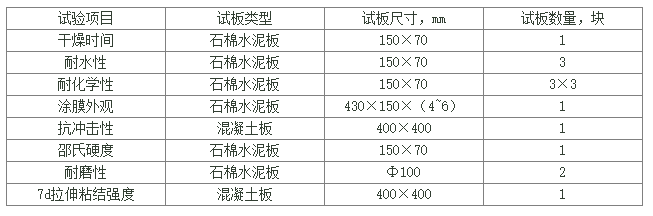
6.3.3 The size and quantity of test plates for each test item shall comply with the provisions of Table 4.
Table 4 Test Plate Requirements for Each Test Item
6.4 Sample and Sample Preparation
6.4.1 Sample Preparation
Mix and stir the components of the epoxy resin floor coating material according to the ratio and method provided by the manufacturer, and prepare the sample uniformly.
6.4.2 Preparation of test specimens
6.4.2.1 Preparation of test specimens: Apply the test specimen onto the surface of the test sample that meets the requirements of 6.3 using the construction method provided by the manufacturer. The thickness of the self leveling epoxy resin floor coating material is (2 ± 0.2) mm. The epoxy resin base coating and the thin coating epoxy resin floor coating material are applied in two coats, with the first coat having a thickness of (120 ± 10) μ m and the second coat having a thickness of (80 ± 10) μ m after 24 hours. After coating, the specimen is cured for 7 days under standard test conditions, which is the specimen.
6.4.2.2 Preparation of 7-day tensile bond strength specimens: Apply the specimens onto the surface of a concrete slab that meets the requirements of 6.3.2 using the construction method provided by the manufacturer. The thickness of the self leveling epoxy resin floor coating material is (2 ± 0.2) mm. The epoxy resin base coating and the thin coating epoxy resin floor coating material are applied in two coats, with the first coat having a thickness of (120 ± 10) μ m and the second coat having a thickness of (80 ± 10) μ m after 24 hours. The preparation area of each specimen is (40 × 40) mm. Multiple specimens can be prepared on a concrete slab, with a distance of not less than 15mm between each specimen. Five specimens are grouped together, and the coated specimens are cured for 7 days under standard test conditions.
6.5 Status in Container
Open the container and allow some sediment to settle at the bottom before stirring. After stirring, observe whether the product has hard lumps and is in a uniform state.
6.6 Coating Appearance
After applying the 6.4.1 sample to the test panel, place it under standard conditions for 48 hours and visually inspect the surface condition of the coating under scattered sunlight.
6.7 Solid content
Conduct the test according to the provisions of GB/T 1725, weigh the sample in 6.4.1, and place it in an oven under standard conditions for 24 hours at a baking temperature of (120 ± 2) ℃.
6.8 Drying time
Test the sample of 6.4.1 according to the dry method and dry method specified in GB/T 1728-1979. The thickness of the self leveling epoxy resin floor coating material is (2 ± 0.2) mm, and the coating thickness of the epoxy resin base coating and thin coating epoxy resin floor coating material is (120 ± 10) μ m.
6.9 Shore hardness
Test the specimen of 6.4.2.1 according to the method specified in GB/T 2411-1980, using a D-type Shore hardness tester.
6.10 Pencil Hardness
Test the sample of 6.4.1 according to the provisions of Method B in GB/T 6739-1996.
6.11 7-day compressive strength
Inject the 6.4.1 sample into a mold with a size of (30 × 30 × 30) mm, and try to avoid the formation of bubbles during the pouring process. Each group consists of 6 pieces. After pouring, they are placed under standard test conditions. After 24 hours, they are demolded and cured for 7 days. The compressive strength is measured according to Article 9.3 of GB/T 17671-1999, and the data is processed according to Article 10.2.2 of GB/T 17671-1999. The test results are accurate to 1 MPa.
6.12 7d tensile bonding strength
Test and process the data using the specimen 6.4.2.2 according to section 5.4 of JC/T907-2003.
6.13 Impact resistance
Place the specimen of 6.4.2.1 tightly onto a 20mm thick fine sand surface, with the coating facing upwards. Then, drop the steel ball freely from a height of 1m and impact it at three points on the specimen. Each impact point should be at least 50mm apart and at least 50mm away from the edge of the specimen. Observe whether there are cracks or peeling on the surface coating of the specimen.
6.14 Liquidity
Test the sample of 6.4.1 according to Article 6.7 of JC/T 985-2005.
6.15 Water resistance and chemical resistance
Test the specimen of 6.4.2.1 according to GB/T 9265, using water, 15% NaOH solution, 10% HCl solution, and 120 # solvent gasoline as immersion media. After soaking for 7 days, remove the specimen and observe whether the coating bubbles, peels off, and changes color.
6.16 Wear resistance
Test the specimen of 6.4.2.1 according to the provisions of 6.9 in JC/T 985-2005.


Phone
15015150026
Douyin account
Douyin account
Video Channel
Video Channel
Top

